
The Psychology of Decision-Making in Mediation – Part 2
By: Philip G. Thompson
Florida Supreme Court Certified Circuit Civil Mediator
Florida Supreme Court Qualified Arbitrator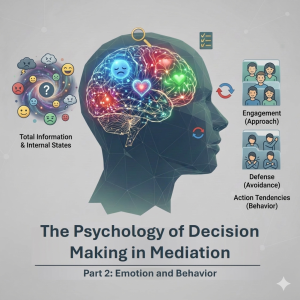
Part Two: Emotion and Behavior
Introduction
This article is the second installment in a two-part series examining the psychological forces that influence decision-making in mediation. The first article addressed cognition—how people think. This installment focuses on how people feel (emotion) and how they act (behavior), and how they interact with cognition to shape decisions during mediation. This discussion is intended as a general overview rather than an in-depth treatment of these concepts.
Why Psychology Matters in Mediation
Mediation outcomes are often driven less by legal and factual issues than by the people involved. An understanding of the psycho-dynamics involved allows litigators to recognize the “game within the game” and to guard against factors that can impair sound decision-making.
Although litigators typically approach mediation with a logical, issue-focused mindset, participants are human, and human decision-making is frequently influenced—often subconsciously—by psychological processes. How information is perceived and acted upon is shaped by these forces. This article focuses on the role of emotion and behavior in that process.
What Are Emotions
The American Psychological Association defines emotions as complex patterns involving experiential, behavioral, and physiological elements through which individuals respond to personally significant events. In practical terms, emotion is a state of awareness that provides information about the world. The nature of the emotion depends on the meaning attributed to the event. A perceived threat may generate fear, while perceived disapproval may generate shame. These built-in behavioral impulses that accompany emotional states are known as “action tendencies”.
How Emotion Influences Decision-Making
It is said that emotions are the silent architects of our decisions. Neurobiologically, cognitive reasoning and emotional processing are intertwined; it is not possible to think entirely without emotion. Even when individuals believe they are analyzing a situation rationally, an emotional response has already been triggered and influences their evaluation. This phenomenon is often referred to as “emotional thought.”
Emotional thought fuels our decision-making and plays a crucial role in the decision-making process. For example, fear can make us overly cautious when trying to make a decision, while anger can lead to an impulsive decision. Emotions also shape how people assess risk versus reward. Positive emotions tend to increase risk tolerance, while negative emotions promote caution or avoidance. In the context of mediation, parties often arrive with strong emotions tied to the dispute, and these emotions influence both their behavior and their decision-making throughout the process.
What Is Behavior
Behavior is how we act and it is the outward expression of internal states, including thoughts and emotions, as well as the response to external stimuli such as the actions of others. Emotions trigger behavior, and as will be shown below, behavior influences decision-making. These processes are closely linked and are not a simple cause-and-effect chain. It is a dynamic interconnected system. At mediation, this dynamic affects not only the parties, but their attorneys too, whose own emotional state and behavior can shape their strategic choices during mediation.
How Emotion Drives Behavior at Mediation
A party’s emotional state directly affects how they behave at mediation, which in turn influences decision-making. Generally, negative emotions typically trigger defensive behaviors while positive emotions tend to trigger social engagement behaviors. For example, expressions of anger in a contentious case may provoke fear or anxiety in the opposing party, triggering a fight-or-flight response. This response can produce physiological changes—such as increased heart rate and adrenaline—that interfere with rational thought. In extreme cases, this leads to “flooding,” where emotional overload impairs cognitive functioning.
Emotional fatigue presents another challenge. Unlike physical fatigue, emotional exhaustion may not be readily apparent, yet it significantly impairs decision-making capacity. This phenomenon, known as “decision fatigue,” occurs when repeated decision-making depletes cognitive resources. As fatigue sets in, our brain looks for shortcuts. Individuals may resort to impulsive decisions because there is insufficient energy to think through the consequences. Or individuals may simply avoid making decisions altogether. Either shortcut can have adverse consequences for mediation.
Even seemingly minor factors, such as hunger, can result in emotional thought. A hungry party may subconsciously seek to end the mediation quickly, leading to rushed or poorly considered decisions. Regardless of the specific negative emotion or behavior in play, the practical effect remains the same: impaired decision-making that hinders the party’s ability to compromise and manage their risk of going to trial.
Conversely, positive emotions like joy, excitement and curiosity produce “approach behaviors” that motivate people to explore, connect and engage. This results in an expanded repertoire of cognition and decision-making that allows a party to be more creative and flexible when it comes to problem solving. This also promotes collaboration and compromise. Quite simply, positive emotions/behavior expands thinking while negative emotions/behavior restricts it.
Recognizing and Addressing Emotions
Emotions will inevitably be present at mediation and will evolve as the process unfolds. Ignoring or suppressing emotions is rarely effective and often escalates conflict. Instead, participants should employ strategies to manage negative emotions and reinforce positive ones. Early identification of the emotional states of both parties and counsel allows mediators and litigators to take steps to preserve constructive emotions or mitigate negative ones that hinder progress.
Effective strategies include:
- Creating a safe environment
- Identifying emotions
- Active listening
- Reframing negative emotions
- Encouraging positive emotions
- Fostering goal setting
Creating a Safe Environment
A foundation of safety and trust enables parties to express emotions without fear of judgment or retaliation. Litigants have a fundamental need to be heard and validated. Early efforts to acknowledge these needs help establish openness and trust. Once this is done, it is important to maintain a safe and trusting atmosphere for the parties.
Emotion Identification
Early “check-ins” regarding emotional state are essential. Questions such as “How are you feeling right now?” or “How has this dispute affected you?” help surface emotions that may otherwise remain unspoken but still influence decision-making. Once an emotion is identified, steps can be taken to either cultivate it or reframe it.
Active Listening
Active listening reinforces safety and trust while clarifying emotional states. By reflecting and summarizing a party’s expressed emotions, the listener validates the party’s experience and encourages open communication. Active listening promotes a safe environment which facilitates emotion identification.
Reframing Negative Emotions
Reframing is a powerful technique for reducing emotional intensity. Inflammatory or value-laden statements can be restated in neutral language to decrease tension and promote constructive dialogue. Asking questions that elicit positive responses can also shift focus away from negativity.
Encouraging Positive Emotions
Positive emotions should be acknowledged and reinforced. Recognizing progress, celebrating small gains, and expressing optimism about potential solutions help maintain a constructive emotional climate. This helps produce “approach behaviors” to expand thinking toward collaboration and compromise.
Fostering Goal Setting
Goal setting provides direction and reduces the impact of negative emotions by shifting focus from past grievances to future outcomes. Establishing shared goals encourages collaboration and reframes the parties’ relationship from adversarial to cooperative. Working toward a common objective changes how the parties view each other and helps quell a negative emotional state. This can generate positive “approach behaviors” designed to increase cooperation and compromise between the parties.
Key Takeaway
Emotion and behavior play a central role in shaping decision making at mediation. They serve as both catalysts and barriers for dispute resolution. Positive emotions foster cooperation and open dialogue, while negative emotions impede compromise and impair decision-making.
Effective litigators manage their own emotions and behaviors while recognizing and addressing those of their clients. Skilled mediators create an environment that supports emotional awareness and constructive behavior. Together, these efforts lead to better decision-making and enhance the likelihood of achieving the core objectives of mediation: compromise and risk management.