
The Psychology of Decision Making in Mediation
By: Philip G. Thompson
Florida Supreme Court Certified Circuit Civil Mediator
Florida Supreme Court Qualified Arbitrator
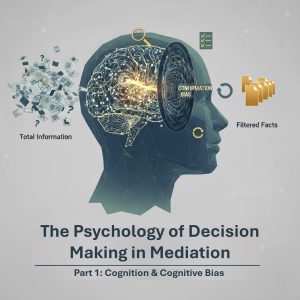
Part One: Cognition & Cognitive Bias
Introduction
This article is the first in a two-part series exploring key psychological dynamics that influence decision making during mediation. We will examine how people think (cognition), how they feel (emotion), and how they behave as a result of both. While each area could be explored in great depth, this series just provides a general overview to get your feet wet.
Why Psychology Matters in Mediation
Mediation outcomes are shaped as much—if not more—by the people involved as opposed to the legal and factual issues framing the dispute. Understanding the psycho-dynamics in play gives litigators insight into the “game within the game,” helping them recognize and navigate the factors that impair sound decision-making.
Litigators often approach mediation with a logical, issue-driven mindset. Ideally, both sides should analyze the issues and evidence objectively and reach a fair resolution of the dispute. But mediation participants are human, and human decision-making is influenced—often subconsciously—by psychological processes that shape how information is acquired and interpreted.
This installment focuses on cognition and the powerful role of cognitive bias.
How Cognition Shapes Beliefs
Human beings absorb information rapidly, and our brains immediately filter it through our experiences, predispositions, and mental shortcuts. Cognition and emotion together form beliefs, which then create expectations. These expectations give rise to cognitive biases—systematic errors in thinking that influence how we interpret information and make decisions.
As William James observed, “a great many people believe they are thinking when they are merely re-arranging their prejudices.” Henri Bergson echoed this and said: “the mind only sees what the mind is prepared to comprehend.”
Both individuals were speaking about cognitive bias.
Confirmation Bias: The Most Disruptive Bias in Mediation
Among the many cognitive biases, confirmation bias is the most problematic in mediation. It is the tendency to seek, interpret, and remember information in ways that support existing beliefs.
There are four specific subsets:
- Biased memory recall – remembering only the information that supports our viewpoint
- Biased interpretation – interpreting information only in a way that supports our position
- Biased search – seeking out information that only supports our argument
- Biased attention – focusing solely on information that supports our position
These patterns often operate subconsciously, making them difficult to detect.
Why Confirmation Bias Occurs
1. Cognitive efficiency:
The brain cannot process all the available information carefully and thoroughly in a short window of time, so it relies on pre-stored mental shortcuts that save time and energy.
2. Self-image protection:
As humans, it is important to us that our pre-conceived beliefs are proven to be accurate. Being wrong threatens our ego. In conflict situations, we subconsciously seek out and interpret information in a way that validates our existing beliefs and shields us from discomfort.
How Confirmation Bias Derails Mediation
Mediation is fundamentally about risk management and compromise. These are the two core pillars of mediation. Both require an honest assessment of one’s own case and that of the opposing party’s case. At mediation, each party is managing their risk of losing at trial by attempting to reach an agreement voluntarily that they can live with. The key factor in reaching such an agreement is compromise.
Confirmation bias disrupts this process by:
- Erroneously inflating confidence in one’s own case
- Mistakenly invalidating the strength of the opposing party’s case
- Reducing the willingness to make concessions
- Increasing the likelihood of an impasse
- Paving the way for a poor trial outcome
The chain reaction is predictable and seen far too often by mediators:
Confirmation Bias -> Reduced Compromise -> Poor Risk Management -> Mediation Impasse -> Bad Trial Result
How to Combat Confirmation Bias
Step One: Awareness
The first step in addressing confirmation bias is recognizing it. Once individuals understand that their thinking is influenced by subconscious filters, they can begin to minimize its impact. As Brené Brown notes, “in the absence of data, the stories we tell ourselves are a combination of our fears and beliefs”. Thus, in a mediation conference, it is imperative to fill in the gaps in our thinking with data (facts) as opposed to ideas or assumptions. Assumptions and narratives—especially those formed long before mediation—fuel confirmation bias. Without facts, parties can easily create self-serving rationalizations that reinforce what they want to believe. To break this cycle, parties must be confronted with verifiable facts. When data conflicts with pre-existing beliefs, awareness emerges, and the individual is forced to reconcile the discrepancy.
Step Two: Openness
Awareness alone is not enough. A party must also be open to considering new information and alternative viewpoints. This is the second step. Awareness of one’s confirmation bias is meaningless unless the individual is open to addressing it. The way to encourage this is by playing devil’s advocate. This chips away at confirmation bias.
This technique:
- Forces examination of one’s own supporting facts
- Forces examination of the opposing party’s supporting facts
- Challenges assumptions and beliefs that are not supported by facts
- Exposes distorted thinking caused by confirmation bias
The Mediator’s Role
An experienced mediator can:
- Identify the facts that the party is distorting
- Ask probing questions that require justification of the party’s position
- Present data that supports the perspective of the opposing party
- Help the parties confront internal contradictions caused by confirmation bias
When parties engage in this process, they can recognize flaws in their assumptions and make a more honest assessment of their position. This facilitates more compromise which in turn fosters better decision making and risk management.
The Discomfort—and the Reward
Confronting confirmation bias requires humility. It can be uncomfortable to acknowledge distorted thinking, but the discomfort is temporary. The long-term benefit—reaching a settlement that removes the risk of trial—is far greater.
As my wife is prone to tell me:
“Do you want to be right, or do you want to be happy?”
Clinging to a flawed belief may feel validating and protect one’s self-image in the moment, but it can lead to an impasse and a poor trial outcome. Feeling “right” about a flawed position at mediation isn’t worth long-term regret after trial. Addressing confirmation bias during mediation improves decision-making and results.
If the mediator is asking tough questions, it’s likely to expose confirmation bias affecting your judgment. Engage with the mediator when challenged—this always helps. The goal is for one of two things to occur: either you will be able to recognize a bias and adjust your thinking accordingly to better manage your trial risk, or you will show the mediator that your position is sound, and the other side is biased. In that case, the mediator can work with the other side to root out their confirmation bias and highlight their distorted thinking.
Looking Ahead
This article introduced the first psycho?dynamic influencing decision-making: cognition.
In the next installment, we will explore the remaining two—emotion and behavior—and how they further shape decision-making.
Understanding these psychological forces is essential for litigators seeking to uphold the two guiding principles of mediation: compromise and risk management.