
Modern Game Theory & Personal Injury Mediation, Part III: Behavioral Game Theory and the Human Element of Resolution
Andrew Winston, Esq.
Florida Supreme Court Certified Circuit Court Mediator
Florida Supreme Court Qualified Arbitrator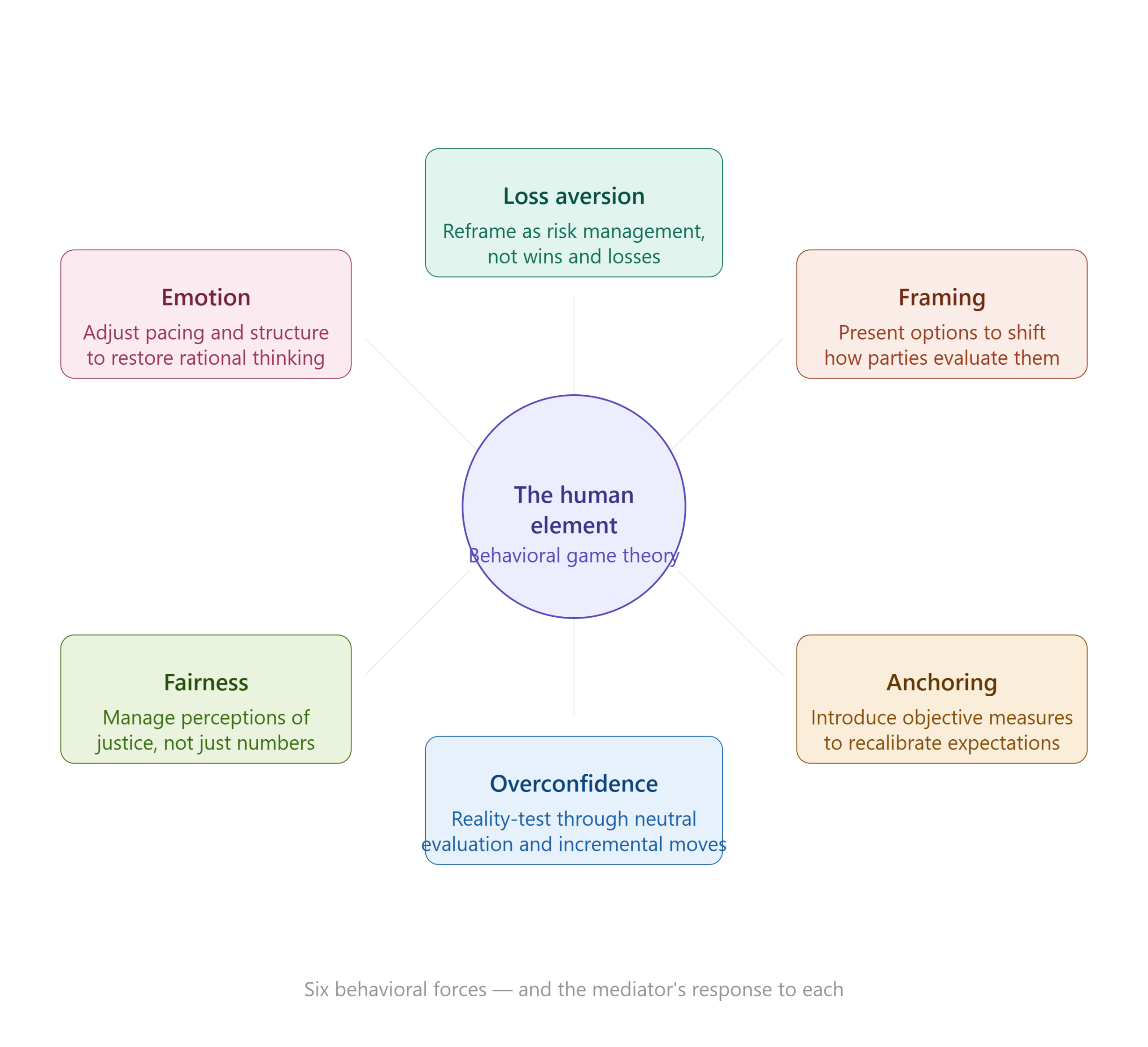
Throughout this series, we have explored how modern game theory provides a powerful framework for understanding personal injury mediation—from strategic positioning to dynamic interaction. This final installment turns to perhaps the most practical dimension: how real people actually make decisions. Behavioral game theory brings the human element into focus, explaining why parties often depart from purely rational models and how mediators can work effectively within that reality.
One of the most influential concepts in this area is loss aversion. Parties tend to weigh potential losses more heavily than equivalent gains. For plaintiffs, this often appears as resistance to accepting a settlement that feels like a concession, even when it reflects strong value in light of litigation risk. Defendants, particularly insurers, may overemphasize the risk of overpaying relative to the cost and uncertainty of trial. Skilled mediators address this by reframing outcomes in terms of risk management and certainty, rather than perceived wins or losses.
Closely related is the concept of framing. The presentation of options can significantly influence how they are evaluated. A settlement framed as a guaranteed recovery and closure may carry more weight than the same figure presented as a reduction from a higher demand. Likewise, describing litigation as a sequence of uncertainties rather than a path to potential upside can shift how both sides assess their positions. Thoughtful framing allows mediators to guide parties toward more balanced and informed decisions.
Anchoring bias also plays a central role in mediation. Initial demands and offers often establish psychological reference points that shape the entire negotiation. While these anchors may be strategically inflated, they nonetheless influence expectations. Rather than attempting to eliminate anchoring, effective mediators work to recalibrate it—introducing objective measures such as comparable verdicts, settlement ranges, and case-specific risks to bring negotiations into a more realistic range.
Another common dynamic is overconfidence. Each side may overestimate the strength of its case or the likelihood of success at trial, creating a gap that is rooted more in perception than strategy. Mediators can narrow this gap through careful reality testing, neutral evaluation, and incremental movement that encourages reassessment without triggering resistance.
Behavioral game theory also emphasizes fairness preferences. Parties are motivated not only by financial outcomes, but by their sense of whether a result is just. A plaintiff who feels heard and respected is more likely to engage constructively, just as a defendant is more likely to respond to a demand perceived as reasonable. Managing these perceptions of fairness is often as important as negotiating the numbers themselves.
Finally, emotional dynamics are not separate from strategy—they are central to it. Frustration, fatigue, and stress can narrow decision-making and entrench positions. Recognizing these patterns allows mediators to adjust pacing, structure conversations effectively, and create conditions where rational evaluation can re-emerge.
As this series has shown, modern game theory is not limited to abstract models or academic theory. When applied thoughtfully, it becomes a practical tool for understanding behavior, managing complexity, and guiding parties toward resolution. By integrating strategic, dynamic, and behavioral insights, mediators can approach each case with greater clarity and effectiveness—ultimately helping parties reach outcomes that are both rational and human.